
Làm chủ IELTS Speaking Part 3 Questions about Money: Từ lý thuyết đến thực chiến
- I. PHƯƠNG PHÁP TRẢ LỜI A.R.E.A CHO IELTS SPEAKING PART 3 QUESTIONS ABOUT MONEY
- II. CÁC CÂU HỎI TIÊU BIỂU VỀ IELTS SPEAKING PART 3 QUESTIONS ABOUT MONEY
- 1. Do you think other people would feel the same in that situation?
- 2. Can you suggest ways to educate people about the dangers of borrowing a lot of money?
- 3. How do you think developments in information technology will alter the way individuals deal with their money in the future?
- 4. How do you predict people’s shopping habits will change in the future?
- 5. What are the long-term impacts of a cashless society?
Trong kỳ thi IELTS, Speaking Part 3 được đánh giá là một trong những phần thử thách nhất vì không chỉ yêu cầu nói trôi chảy mà còn đòi hỏi phát triển ý tưởng và lập luận rõ ràng. Đặc biệt, khi đối mặt với IELTS Speaking Part 3 Questions about Money, nhiều thí sinh dễ bí ý hoặc trả lời thiếu chiều sâu. Vì vậy, việc biết cách mở rộng ý, dùng ví dụ hợp lý và lựa chọn từ vựng phù hợp sẽ giúp bạn tránh mất điểm đáng tiếc.
Nếu bạn muốn tìm hiểu thêm các khóa luyện IELTS, hãy truy cập STV English để khám phá các khóa học chuyên sâu.
I. PHƯƠNG PHÁP TRẢ LỜI A.R.E.A CHO IELTS SPEAKING PART 3 QUESTIONS ABOUT MONEY
Đối với các IELTS Speaking Part 3 Questions about Money, việc trả lời theo cảm tính thường khiến thí sinh dễ lan man và thiếu trọng tâm. Vì vậy, áp dụng một cấu trúc rõ ràng như A.R.E.A được xem là “chìa khóa vàng” để đảm bảo bài nói mạch lạc và thuyết phục hơn.
- A - Answer (Trả lời trực tiếp): Ngay khi nhận câu hỏi, bạn nên đưa ra quan điểm rõ ràng thay vì vòng vo. Điều này giúp tạo ấn tượng về sự tự tin và kiểm soát nội dung.
- R - Reason (Giải thích lý do): Sau đó, hãy phát triển câu trả lời bằng cách đưa ra lý do hợp lý hoặc lập luận logic để làm rõ ý kiến của mình.
- E - Example (Dẫn chứng cụ thể): Việc bổ sung ví dụ thực tế hoặc tình huống quen thuộc sẽ giúp câu trả lời trở nên sinh động và dễ hiểu hơn.
Lưu ý: Ở Speaking Part 3, tránh lạm dụng ví dụ quá cá nhân để làm dẫn chứng cho phần trả lời của mình.
- A - Alternative/Conclusion (Mở rộng hoặc Kết luận): Cuối cùng, bạn có thể thêm một góc nhìn khác hoặc tóm tắt lại ý chính để hoàn thiện câu trả lời.
Phương pháp này không chỉ giúp bài nói có cấu trúc rõ ràng mà còn thể hiện tư duy phản biện khi xử lý các IELTS Speaking Part 3 Questions about Money. Đồng thời, khi áp dụng A.R.E.A vào IELTS Speaking Part 3 topic finance, bạn sẽ dễ dàng kiểm soát thời gian, tránh bị ngập ngừng và duy trì sự trôi chảy xuyên suốt phần thi.
Lưu ý: Ví dụ trong Part 3 không bị cấm là cá nhân, nhưng nên mang tính đại diện hoặc có thể liên hệ rộng hơn đến xã hội. Điều này giúp câu trả lời mang tính học thuật và phù hợp với tiêu chí chấm điểm của IELTS.
II. CÁC CÂU HỎI TIÊU BIỂU VỀ IELTS SPEAKING PART 3 QUESTIONS ABOUT MONEY
Để làm tốt các câu hỏi về chủ đề tiền bạc trong Speaking Part 3, các thí sinh cần nắm vững cách trả lời cho những câu hỏi phức tạp. Dưới đây là một số câu hỏi điển hình:
1. Do you think other people would feel the same in that situation?
Gợi ý trả lời:
"It really depends, because people tend to react differently based on their personal circumstances. That said, a large number of individuals would probably feel the same, especially when money is involved, since there’s an innate desire for financial security. However, those from different socio-economic backgrounds might interpret the situation quite differently. For instance, someone who has grown up in a financially stable environment may not feel the same pressure as someone who has faced economic hardship."
Phân tích theo A.R.E.A:
- A: “It really depends”
- R: “people react differently…”
- E: “especially when money is involved…”
- A: “However, those from different backgrounds…”
Đây là một câu trả lời tốt vì:
- Có sự cân bằng giữa khái quát và cụ thể
- Thể hiện tư duy đa chiều
Từ vựng:
- Innate (adj): bẩm sinh
- Circumstances (n): hoàn cảnh
- Financial security: sự an toàn/ổn định tài chính
2. Can you suggest ways to educate people about the dangers of borrowing a lot of money?
Gợi ý trả lời:
“There are several effective ways to educate people about the dangers of borrowing too much money. This is mainly because many individuals lack basic financial knowledge, which makes them more vulnerable to debt-related problems. For example, financial literacy could be integrated into the education system from an early age. If students are exposed to real-life scenarios such as credit card debt or loan repayments, they will develop a clearer understanding of the long-term consequences of excessive borrowing. In addition, governments and financial institutions could run awareness campaigns or use social media to highlight these risks, making the information more accessible and relatable to the general public.”
Phân tích theo A.R.E.A:
- A: “There are several effective ways…”
- R: “This is mainly because…”
- E: “For example, financial literacy could be…”
- A: “In addition, governments and financial institutions…”
Từ vựng:
- Literacy (n) (financial literacy): kiến thức (kiến thức tài chính)
- Consequences (n): hậu quả
- Excessive borrowing: vay mượn quá mức
Khám phá ngay IELTS Speaking Part 3 Social Problems: Câu hỏi thường gặp & cách trả lời hiệu quả tại đây.
3. How do you think developments in information technology will alter the way individuals deal with their money in the future?
Gợi ý trả lời:
"I believe advancements in technology will significantly transform the way people manage their finances because digital innovations are making financial transactions more efficient and accessible to a wider population. For instance, digital banking and mobile payment apps are streamlining transactions, making them faster and more convenient. In addition, many people are becoming increasingly reliant on automated tools such as budgeting apps or AI-driven investment platforms to manage their money more effectively. This growing dependence on technology also raises concerns about data security and cyber fraud, which are likely to become more sophisticated over time."
Phân tích theo A.R.E.A:
- A: “I believe advancements in technology will significantly transform…”
- R: “because digital innovations…”
- E: “For instance, digital banking and mobile payment apps..."
- A: “This growing dependence…”
Từ vựng:
- Streamline (v): tối ưu hóa / làm đơn giản hơn
- Reliant (adj): phụ thuộc
- Cyber fraud: gian lận mạng
4. How do you predict people’s shopping habits will change in the future?
Gợi ý trả lời:
"I’d expect shopping habits to change quite dramatically in the future, particularly due to the rapid development of AI and big data, as these technologies are reshaping consumer behavior. For example, consumers will likely enjoy more personalized shopping experiences, where products are tailored to their preferences almost instantly. In addition, convenience will become a top priority, so more people may turn to subscription-based services and one-click purchases to save time and effort. This could also be a problem, especially when this shift leads to a decline in traditional shopping methods, as physical stores may gradually become less relevant in an increasingly digital world.”
Phân tích theo A.R.E.A:
- A: “I’d expect shopping habits…”
- R: “particularly due to…”
- E: “For example, consumers will likely..."
- A: “This could also be a problem…”
Từ vựng:
- One-click purchases: mua hàng chỉ với một cú nhấp chuột
- Tailored (adj): được cá nhân hóa / thiết kế riêng
- Subscription-based services: dịch vụ theo hình thức đăng ký
5. What are the long-term impacts of a cashless society?
Gợi ý trả lời:
"A cashless society could have several significant long-term impacts, as digital transactions are becoming increasingly dominant in everyday life. For example, it would make financial activities more efficient and convenient, allowing people to make instant payments and track their spending more easily through digital platforms. In addition, it could help reduce issues such as theft and tax evasion, since transactions are recorded electronically. That being said, a fully cashless society may also create challenges, particularly for older individuals or those without access to technology, potentially leading to financial exclusion."
Phân tích theo A.R.E.A:
- A: “A cashless society could have…”
- R: “as digital transactions…”
- E: “For example, it would make..."
- A: “That being said…”
Từ vựng:
- Digital transactions: giao dịch điện tử
- Tax evasion: trốn thuế
- Recorded electronically: được ghi lại bằng điện tử
Các câu trả lời gợi ý trên được đánh giá là hiệu quả nhờ cấu trúc rõ ràng, lập luận chặt chẽ và khả năng thể hiện góc nhìn đa chiều, từ đó đáp ứng tốt các tiêu chí về phát triển ý và tư duy phản biện trong IELTS Speaking Part 3.
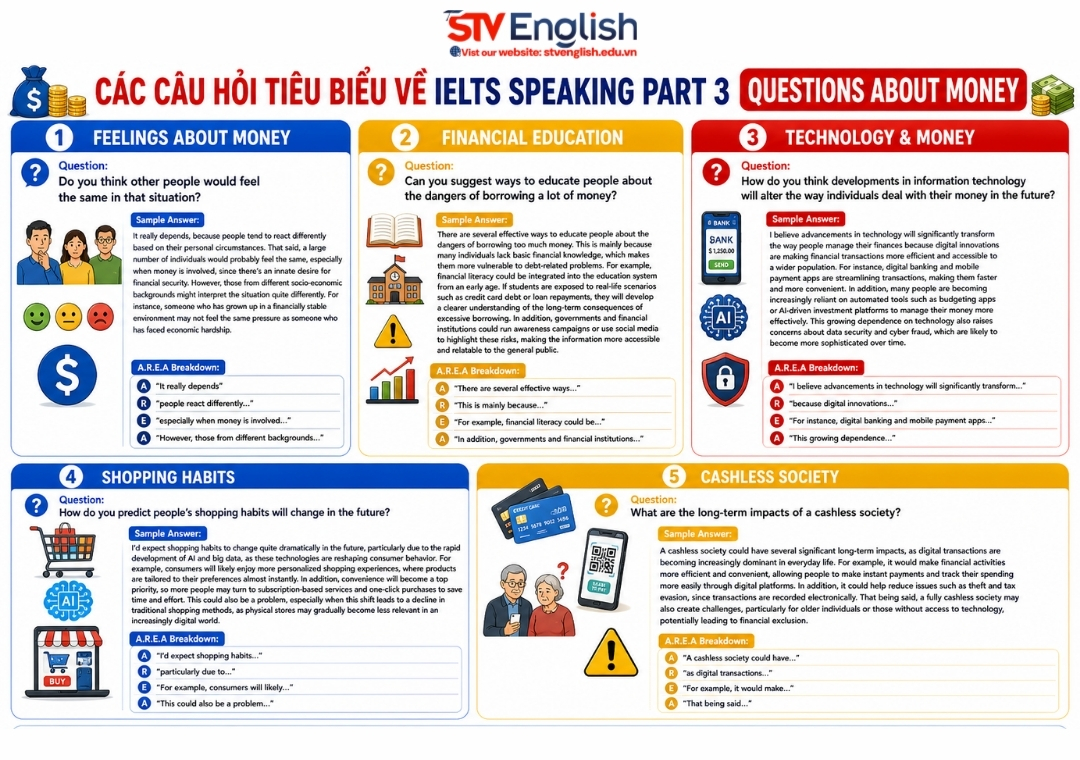
IELTS Speaking Part 3 Questions about Money
Nhìn chung, việc luyện tập kỹ lưỡng với các IELTS Speaking Part 3 Questions about Money không chỉ giúp người học tự tin trong phòng thi mà còn trang bị kỹ năng quản lý tài chính thực tế. Những câu hỏi thuộc IELTS Speaking Part 3 topic finance thực chất rất gần gũi nếu bạn biết cách liên hệ với cuộc sống hàng ngày.
Khám phá ngay Khóa học IELTS - Nâng Band cấp Tốc, Cải Thiện Toàn Diện Các Kỹ Năng tại đây.
Nếu bạn đang tìm kiếm một môi trường học tập chuyên nghiệp để luyện thi IELTS hiệu quả, STV English là một trong những lựa chọn đáng cân nhắc. Đội ngũ giáo viên giàu kinh nghiệm giúp học viên không chỉ nắm vững phương pháp trả lời các câu hỏi mang tính thử thách mà còn cải thiện tư duy tiếng Anh một cách toàn diện.
👉 Nếu bạn thấy bài viết hữu ích, hãy chia sẻ cho bạn bè và đừng quên nhấp tại đây để khám phá các bài viết hữu ích của STV English.
👉 Cùng lắng nghe những chia sẻ chân thật từ học viên đã từng học IELTS tại STV English và khám phá hành trình chinh phục mục tiêu tiếng Anh nhé!
From: Ms. Flora Thu.
Xem thêm