
IELTS Speaking Part 3 Questions Family : Câu hỏi phổ biến & câu trả lời mẫu
- I. TỪ VỰNG VÀ COLLOCATION HAY CHO IELTS SPEAKING PART 3 QUESTIONS FAMILY
- 1. Nhóm từ vựng về cấu trúc và mối quan hệ gia đình
- 2. Nhóm từ vựng về trách nhiệm và giá trị
- 3. Nhóm từ vựng về sự thay đổi xã hội
- II. IELTS SPEAKING PART 3 QUESTIONS FAMILY: GỢI Ý CÂU TRẢ LỜI MẪU
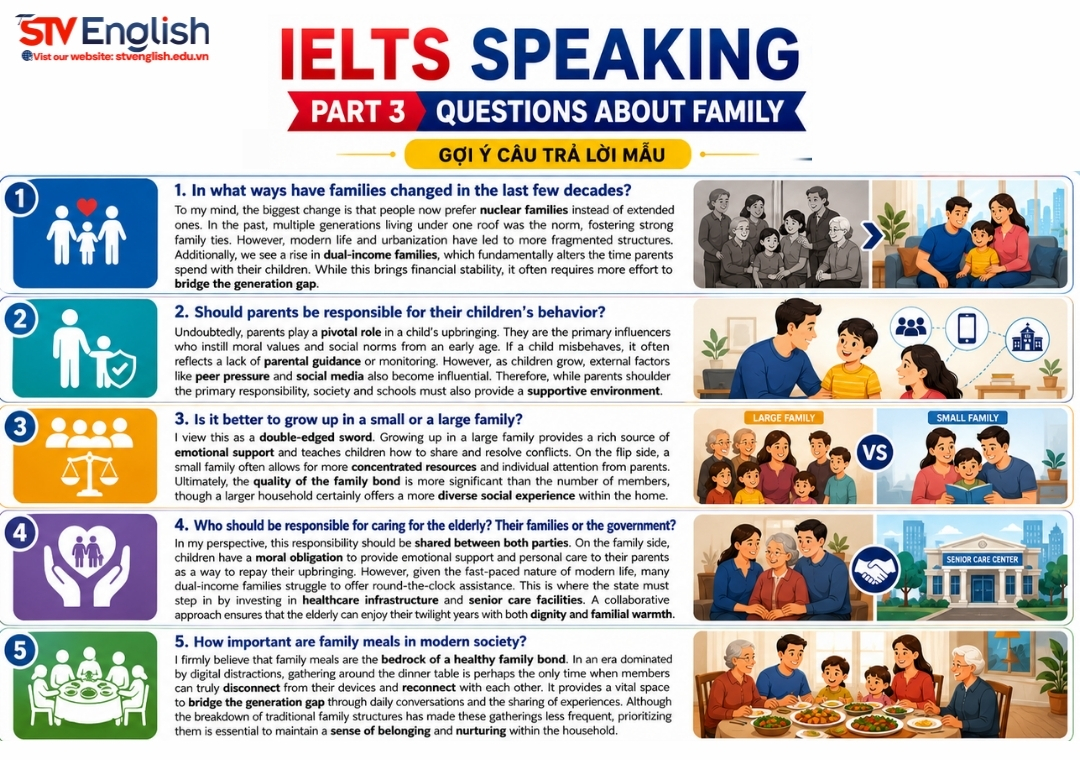
- 1. In what ways have families changed in the last few decades?
- 2. Should parents be responsible for their children's behavior?
- 3. Is it better to grow up in a small or a large family?
- 4. Who should be responsible for caring for the elderly? Their families or the government?
- 5. How important are family meals in modern society?
Trong tiêu chí đánh giá của giám khảo, Part 3 là nơi sự khác biệt về năng lực của các thí sinh rõ rệt nhất thông qua khả năng mở rộng vấn đề từ cá nhân ra xã hội. Đặc biệt, với chủ đề gần gũi nhưng đầy tính triết lý như IELTS Speaking Part 3 topic family, thí sinh rất dễ rơi vào cách trả lời quá đơn giản. Hãy cùng khám phá cách biến những ý tưởng quen thuộc thành những lập luận hay và gây ấn tượng tốt với giám khảo.
Nếu bạn muốn tìm hiểu thêm các khóa luyện IELTS, hãy truy cập STV English để khám phá các khóa học chuyên sâu.
I. TỪ VỰNG VÀ COLLOCATION HAY CHO IELTS SPEAKING PART 3 QUESTIONS FAMILY
Để đạt band 7.5+ IELTS Speaking, việc sử dụng từ vựng đơn lẻ là chưa đủ. Thí sinh cần sử dụng linh hoạt các cụm từ cố định (collocations) mang tính học thuật để tối ưu điểm tiêu chí Lexical Resource. Dưới đây là kho từ vựng chuyên sâu giúp bài nói về IELTS Speaking Part 3 topic family thêm thuyết phục.
1. Nhóm từ vựng về cấu trúc và mối quan hệ gia đình
- Nuclear family vs. Extended family: Gia đình hạt nhân (2 thế hệ) >< Gia đình đa thế hệ.
- Family bond / Ties: Sự gắn kết giữa các thành viên trong gia đình.
- To bridge the generation gap: Thu hẹp khoảng cách thế hệ.
- Upbringing / Nurturing: Sự nuôi dưỡng và giáo dục từ nhỏ.
2. Nhóm từ vựng về trách nhiệm và giá trị
- Breadwinner: Trụ cột kinh tế trong gia đình.
- To instill moral values in children: Thấm nhuần các giá trị đạo đức cho con cái.
- Family tradition / Heritage: Truyền thống và di sản gia đình.
- To shoulder family responsibilities: Gánh vác trách nhiệm gia đình.
3. Nhóm từ vựng về sự thay đổi xã hội
- The breakdown of traditional family structures: Sự tan vỡ của cấu trúc gia đình truyền thống.
- Dual-income families: Gia đình có cả bố và mẹ cùng đi làm.
- Delayed parenthood: Việc có con muộn.
- A source of emotional support: Nguồn hỗ trợ về mặt tinh thần.
II. IELTS SPEAKING PART 3 QUESTIONS FAMILY: GỢI Ý CÂU TRẢ LỜI MẪU
1. In what ways have families changed in the last few decades?
Câu trả lời:
"To my mind, the biggest change is that people now prefer nuclear families instead of extended ones. In the past, multiple generations living under one roof was the norm, fostering strong family ties. However, modern life and urbanization have led to more fragmented structures. Additionally, we see a rise in dual-income families, which fundamentally alters the time parents spend with their children. While this brings financial stability, it often requires more effort to bridge the generation gap."
Từ vựng ghi điểm:
- Extended families vs Nuclear families (Gia đình đa thế hệ đối lập với gia đình hạt nhân)
- Fostering strong family ties (Thúc đẩy sự gắn kết gia đình bền chặt)
- Fragmented structures (Cấu trúc (gia đình) bị phân mảnh/chia nhỏ)
- Financial stability (Ổn định tài chính)
2. Should parents be responsible for their children's behavior?
Câu trả lời:
"Undoubtedly, parents play a pivotal role in a child's upbringing. They are the primary influencers who instill moral values and social norms from an early age. If a child misbehaves, it often reflects a lack of parental guidance or monitoring. However, as children grow, external factors like peer pressure and social media also become influential. Therefore, while parents shoulder the primary responsibility, society and schools must also provide a supportive environment."
Từ vựng ghi điểm:
- Play a pivotal role (Đóng vai trò then chốt)
- Upbringing (Sự nuôi dưỡng và giáo dục)
- Instill moral values (Thấm nhuần/lồng ghép các giá trị đạo đức)
- Parental guidance (Sự định hướng/hướng dẫn của cha mẹ)
Khám phá ngay Improve Your IELTS Reading Skills Macmillan PDF tải miễn phí – Tài liệu nâng band Reading từ 6.0 lên 7.5 tại đây.
3. Is it better to grow up in a small or a large family?
Câu trả lời:
"I view this as a double-edged sword. Growing up in a large family provides a rich source of emotional support and teaches children how to share and resolve conflicts. On the flip side, a small family often allows for more concentrated resources and individual attention from parents. Ultimately, the quality of the family bond is more significant than the number of members, though a larger household certainly offers a more diverse social experience within the home."
Từ vựng ghi điểm:
- Double-edged sword (Con dao hai lưỡi)
- Source of emotional support (Nguồn hỗ trợ về mặt cảm xúc)
- Family bond (Sự gắn kết gia đình)
4. Who should be responsible for caring for the elderly? Their families or the government?
Câu trả lời:
"In my perspective, this responsibility should be shared between both parties. On the family side, children have a moral obligation to provide emotional support and personal care to their parents as a way to repay their upbringing. However, given the fast-paced nature of modern life, many dual-income families struggle to offer round-the-clock assistance. This is where the state must step in by investing in healthcare infrastructure and senior care facilities. A collaborative approach ensures that the elderly can enjoy their twilight years with both dignity and familial warmth."
Từ vựng ghi điểm:
- Moral obligation (Nghĩa vụ đạo đức)
- Dual-income families (Gia đình cả bố mẹ cùng đi làm)
- Twilight years (Những năm tháng xế chiều)
- Collaborative approach (Cách tiếp cận mang tính hợp tác)
5. How important are family meals in modern society?
Câu trả lời:
"I firmly believe that family meals are the bedrock of a healthy family bond. In an era dominated by digital distractions, gathering around the dinner table is perhaps the only time when members can truly disconnect from their devices and reconnect with each other. It provides a vital space to bridge the generation gap through daily conversations and the sharing of experiences. Although the breakdown of traditional family structures has made these gatherings less frequent, prioritizing them is essential to maintain a sense of belonging and nurturing within the household."
Từ vựng ghi điểm:
- The bedrock of (Nền tảng của...)
- Digital distractions (Sự xao nhãng từ thiết bị số)
- Bridge the generation gap (Thu hẹp khoảng cách thế hệ)
- A sense of belonging (Cảm giác thuộc về/sự gắn kết)
IELTS Speaking Part 3 Questions Family : Câu hỏi phổ biến & câu trả lời mẫu
Chinh phục band điểm cao IELTS Speaking không chỉ là học thuộc lòng, mà còn là làm chủ kỹ năng tư duy và diễn đạt. Tuy nhiên, trên thực tế, việc tự học đôi khi khiến người học khó nhận ra lỗi sai hoặc thiếu định hướng rõ ràng. Vì vậy, việc luyện tập trong một môi trường có hướng dẫn bài bản sẽ giúp bạn tiến bộ nhanh hơn.
Khám phá ngay Khóa học IELTS - Nâng Band cấp Tốc, Cải Thiện Toàn Diện Các Kỹ Năng tại đây.
Nếu bạn đang tìm kiếm một lộ trình học IELTS Speaking hiệu quả và thực tế, STV English là lựa chọn đáng cân nhắc. Inbox ngay để được test trình độ miễn phí và nhận tư vấn chi tiết phù hợp với mục tiêu của bạn.
Hãy để STV English giúp bạn rút ngắn con đường đến với mục tiêu bằng lộ trình học tinh gọn và thực tế nhất.
👉 Nếu bạn thấy bài viết hữu ích, hãy chia sẻ cho bạn bè và đừng quên nhấp tại đây để khám phá các bài viết hữu ích của STV English.
👉 Cùng lắng nghe những chia sẻ chân thật từ học viên đã từng học IELTS tại STV English và khám phá hành trình chinh phục mục tiêu tiếng Anh nhé!
From: Ms. Flora Thu.
Xem thêm