
IELTS Speaking Part 3 - Topic Education: 30+ Questions & Sample Answers Band 8+
- I. CHIẾN THUẬT "HACK" ĐIỂM IELTS SPEAKING PART 3 TOPIC EDUCATION TỪ GIÁM KHẢO
- 1. Dạng Opinion (Nêu quan điểm cá nhân)
- 2. Dạng Compare (So sánh đối chiếu)
- 3. Dạng Cause & Effect (Nguyên nhân - Hệ quả)
- 4. Dạng Future Prediction (Dự đoán tương lai)
- 5. Dạng Advantages & Disadvantages (Lợi ích & Bất cập)
- II. 30+ IELTS SPEAKING PART 3 EDUCATION QUESTIONS AND ANSWERS
- 1. Education System (Hệ thống giáo dục)
- 2. Online Learning & Technology in Education (Học trực tuyến & Công nghệ)
- 3. Educational Pressure & Exams (Áp lực học tập & Thi cử)
- 4. Lifelong Learning (Học tập suốt đời)
- III. CHIẾN THUẬT D-E-E-B: "BẢN THIẾT KẾ" TRẢ LỜI BAND 8.0+ CHO IELTS SPEAKING PART 3 TOPIC EDUCATION
Trong kỳ thi IELTS, IELTS Speaking Part 3 Topic Education luôn nằm trong nhóm những chủ đề "kinh điển" và xuất hiện với tần suất dày đặc. Khác với Part 1 tập trung vào trải nghiệm cá nhân, Part 3 yêu cầu thí sinh phải có khả năng phân tích đa chiều, tư duy phản biện và sử dụng ngôn ngữ học thuật để thảo luận về các vấn đề giáo dục mang tính vĩ mô. Việc chuẩn bị kỹ lưỡng các dạng câu hỏi và từ khóa liên quan đến giáo dục không chỉ giúp bạn tự tin mà còn là chìa khóa để chạm tay vào Band 8.0+.
Nếu bạn muốn tìm hiểu thêm các khóa luyện IELTS, hãy truy cập STV English để khám phá các khóa học chuyên sâu.
I. CHIẾN THUẬT "HACK" ĐIỂM IELTS SPEAKING PART 3 TOPIC EDUCATION TỪ GIÁM KHẢO
Trong phần thi này, giám khảo không còn đánh giá dựa trên trải nghiệm cá nhân (Personal experience) như Part 1, mà họ tìm kiếm khả năng Critical Thinking (Tư duy phản biện) về các vấn đề vĩ mô. Để đạt điểm tuyệt đối cho IELTS Speaking Part 3 Topic Education, việc nhận diện 5 "mẫu chốt" câu hỏi sau đây là bước đệm quan trọng nhất giúp bạn đảm bảo tiêu chí Coherence and Cohesion (Mạch lạc và Kết nối).
1. Dạng Opinion (Nêu quan điểm cá nhân)
Đây là dạng câu hỏi yêu cầu bạn đưa ra lập trường rõ ràng về một vấn đề giáo dục.
- Câu hỏi điển hình: Is higher education necessary for a successful career?
- Mẹo: Đừng chỉ trả lời "Yes" hoặc "No", hãy sử dụng các cụm từ dẫn dắt như "From my perspective..." hoặc "I’m of the opinion that..." để tăng tính học thuật.
2. Dạng Compare (So sánh đối chiếu)
Giám khảo muốn thấy bạn có khả năng phân tích sự khác biệt giữa các mô hình hoặc thời kỳ.
- Câu hỏi điển hình: What are the differences between studying in a classroom and studying online?
- Mẹo: Sử dụng các liên từ tương phản (whereas, in contrast, on the flip side) để làm nổi bật sự so sánh.
3. Dạng Cause & Effect (Nguyên nhân - Hệ quả)
Dạng này kiểm tra khả năng suy luận logic về các hiện tượng trong giáo dục.
- Câu hỏi điển hình: Why do many students feel burnt out nowadays?
- Mẹo: Áp dụng cấu trúc "Rooted from..." (Bắt nguồn từ) và dẫn dắt đến "Leading to..." (Dẫn đến) để câu trả lời có chiều sâu.
4. Dạng Future Prediction (Dự đoán tương lai)
Bạn cần thể hiện khả năng suy đoán dựa trên xu hướng hiện tại của công nghệ và xã hội.
- Câu hỏi điển hình: How will Artificial Intelligence transform schools in the next decade?
- Mẹo: Sử dụng các modal verbs ở mức độ dự đoán như "It is highly likely that..." hoặc "Predictably, AI will..."
5. Dạng Advantages & Disadvantages (Lợi ích & Bất cập)
Đây là "mỏ vàng" để bạn phô diễn từ vựng về tính hai mặt của một vấn đề.
- Câu hỏi điển hình: What are the drawbacks of standardized testing?
- Mẹo: Luôn cân bằng câu trả lời bằng cách dùng cấu trúc "While there are certain benefits, the downsides are equally significant."
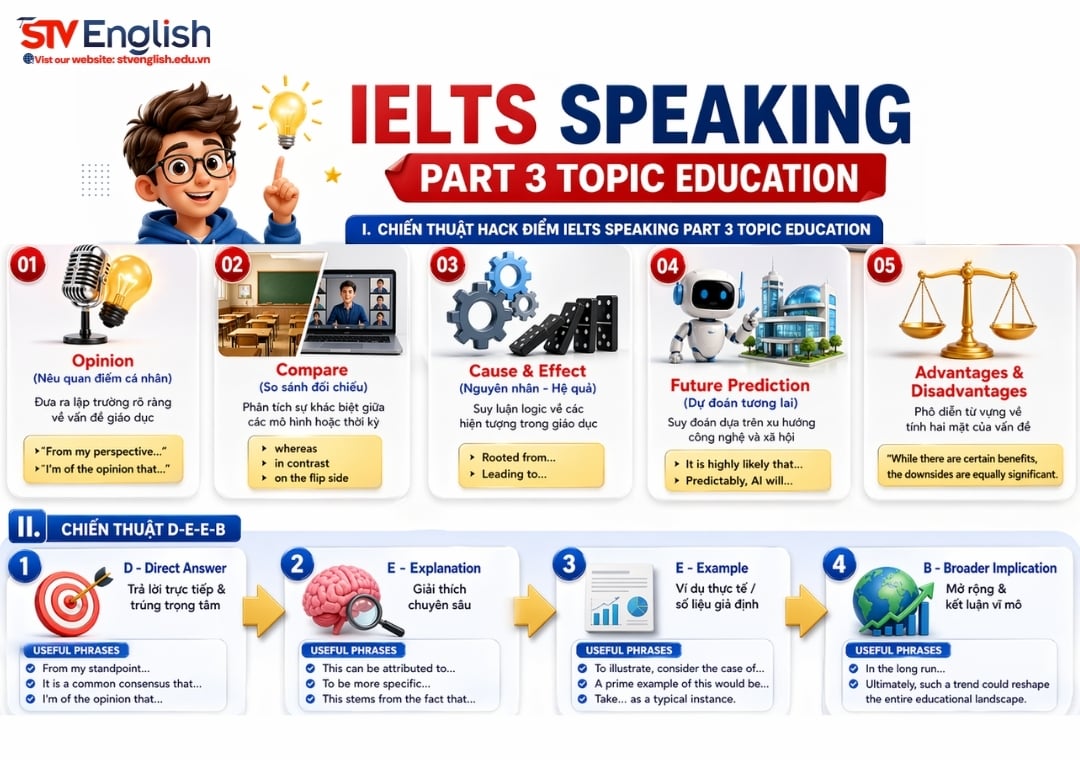
Chiến thuật hack điểm IELTS Speaking Part 3 Topic Education
II. 30+ IELTS SPEAKING PART 3 EDUCATION QUESTIONS AND ANSWERS
Dưới đây là tổng hợp các câu hỏi và câu trả lời mẫu được biên soạn theo tiêu chuẩn Band 8.0+, tập trung vào sự mạch lạc và từ vựng chuyên sâu.
1. Education System (Hệ thống giáo dục)
Question: Should university education be free for everyone?
Sample Answer: "From my perspective, making tertiary education tuition-free is a double-edged sword. On the one hand, it promotes social mobility by ensuring that talented individuals from underprivileged backgrounds have equal access to high-quality instruction. This could lead to a more skilled workforce and boost national economic growth. However, providing free education for all puts an enormous strain on the national budget. Governments might have to increase taxes or redirect funds from other essential sectors like healthcare. Furthermore, there’s a risk of degree inflation, where a university diploma becomes less valuable because everyone possesses one. Therefore, I believe a hybrid model, where subsidies are provided based on financial need or academic merit, would be more sustainable than a blanket 'free for all' policy."
Question: How can governments improve public education?
Sample Answer: "Improving public education requires a multi-faceted approach. First and foremost, curriculum reform is essential to ensure that what students learn is relevant to the demands of the modern job market, focusing more on critical thinking skills rather than rote memorization. Secondly, increasing investment in teacher training and competitive salaries is crucial. Teachers are the backbone of any educational system, and by attracting top-tier talent to the profession, the quality of instruction will naturally rise. Lastly, upgrading technological infrastructure in rural schools is vital to bridge the educational gap between urban and rural areas."
| Từ vựng / Cấu trúc | Nghĩa / Ngữ cảnh sử dụng | Ghi chú Band 8.0+ |
|---|---|---|
| A double-edged sword | Con dao hai lưỡi | Cách diễn đạt thay cho "has both pros and cons". |
| Tertiary education | Giáo dục đại học (cao đẳng) | Từ đồng nghĩa cao cấp cho "university education". |
| Social mobility | Sự dịch chuyển xã hội | Khả năng thay đổi địa vị kinh tế/xã hội nhờ giáo dục. |
| Underprivileged backgrounds | Hoàn cảnh khó khăn | Cách nói lịch sự, học thuật thay cho "poor people". |
| Degree inflation | Sự lạm phát bằng cấp | Tình trạng bằng cấp quá phổ biến dẫn đến mất giá trị. |
| A hybrid model | Mô hình hỗn hợp | Kết hợp nhiều phương pháp. |
| Rote memorization | Học vẹt | Học thuộc lòng máy móc. |
| Top-tier talent | Nhân tài hàng đầu | Nhấn mạnh chất lượng xuất sắc. |
2. Online Learning & Technology in Education (Học trực tuyến & Công nghệ)
Question: Is online learning as effective as traditional classroom learning?
Sample Answer: "While online learning offers unparalleled flexibility and convenience, I don't believe it's a complete substitute for traditional classrooms, especially for younger learners. Digital platforms are excellent for delivering theoretical knowledge and allowing students to learn at their own pace. However, the traditional setting provides a structured environment and facilitates face-to-face interaction, which is fundamental for developing social skills and collaborative abilities. In a physical classroom, teachers can provide immediate feedback and pick up on non-verbal cues that are often lost behind a screen. Thus, I’d argue that a blended learning approach is the most effective way forward in this digital era."
Question: Will AI replace teachers in the future?
Sample Answer: "In my view, AI will significantly transform the role of educators rather than replacing them entirely. Artificial Intelligence is incredibly efficient at personalizing learning paths, grading assignments, and providing data-driven insights into a student’s progress. However, education is not just about the transfer of information; it’s about mentorship, emotional support, and moral guidance—qualities that AI currently lacks. A teacher inspires, motivates, and understands the nuances of human struggle. Therefore, I foresee a future where AI acts as a powerful teaching assistant, handling administrative tasks and basic tutoring, while human teachers focus on the holistic development of their students."
| Từ vựng / Cấu trúc | Nghĩa / Ngữ cảnh sử dụng | Ghi chú Band 8.0+ |
|---|---|---|
| Unparalleled flexibility | Sự linh hoạt vô song | Tính từ nhấn mạnh ưu điểm nổi bật. |
| A complete substitute | Sự thay thế hoàn toàn | Thường dùng khi nói về công nghệ. |
| Non-verbal cues | Các tín hiệu phi ngôn ngữ | Ánh mắt, cử chỉ, điệu bộ. |
| Blended learning | Học tập kết hợp | Kết hợp online và offline. |
| Personalizing learning paths | Cá nhân hóa lộ trình học | AI điều chỉnh nội dung theo trình độ. |
| The holistic development | Sự phát triển toàn diện | Trí tuệ, đạo đức, thể chất và kỹ năng. |
3. Educational Pressure & Exams (Áp lực học tập & Thi cử)
Question: Why are students under so much pressure nowadays?
Sample Answer: "The escalating pressure on students today stems from several factors. The primary driver is the hyper-competitive nature of the modern labor market. Students are often told that only those with top-tier grades and prestigious degrees can secure high-paying jobs, leading to a relentless pursuit of academic performance. Additionally, parental expectations play a significant role; many parents project their own ambitions onto their children, forcing them into grueling schedules of extra classes. Lastly, the prevalence of standardized testing creates a 'high-stakes' environment where a single exam score can determine a student’s entire future, leaving little room for error or creative exploration."
Question: Are exams the best way to assess a student’s ability?
Sample Answer: "I believe that while exams provide a standardized metric for comparison, they are far from being the 'best' way to gauge true ability. Exams often test a student’s memory and performance under stress rather than their actual understanding or practical application of knowledge. Many students who excel in real-world projects or creative problem-solving may struggle with the rigid format of a written test. A more comprehensive assessment should include continuous evaluation, such as portfolios, presentations, and peer-to-peer assessments. This would provide a more accurate and holistic picture of a student's strengths and weaknesses."
| Từ vựng / Cấu trúc | Nghĩa / Ngữ cảnh sử dụng | Ghi chú Band 8.0+ |
|---|---|---|
| Hyper-competitive nature | Bản chất cực kỳ cạnh tranh | Mô tả môi trường học tập hoặc lao động. |
| The relentless pursuit of... | Sự theo đuổi không ngừng nghỉ | Thường dùng với academic performance. |
| Standardized testing | Các kỳ thi chuẩn hóa | Ví dụ: IELTS, SAT. |
| A high-stakes environment | Môi trường đầy áp lực | Một sai lầm có thể gây hậu quả lớn. |
| A standardized metric | Một thước đo tiêu chuẩn | Đánh giá tính công bằng của kỳ thi. |
| Continuous evaluation | Đánh giá liên tục | Đánh giá cả quá trình học tập. |
Khám phá ngay IELTS Speaking Part 3 Tips & Strategies Band 8+ tại đây.
4. Lifelong Learning (Học tập suốt đời)
Question: Should adults continue studying after they start working?
Sample Answer: "Absolutely. In today’s rapidly evolving world, lifelong learning is no longer a luxury but a necessity. The phenomenon of 'skills obsolescence' means that the knowledge one acquired a decade ago may no longer be relevant today. By pursuing further education or professional certifications, adults can stay competitive in their fields and adapt to new technological advancements. Moreover, continuous learning keeps the mind sharp and can lead to greater job satisfaction and personal fulfillment. Whether it’s attending a weekend workshop or enrolling in an executive MBA, staying curious is key to long-term career success."
| Từ vựng / Cấu trúc | Nghĩa / Ngữ cảnh sử dụng | Ghi chú Band 8.0+ |
|---|---|---|
| Skills obsolescence | Sự lỗi thời của kỹ năng | Kiến thức cũ không còn phù hợp. |
| Professional certifications | Chứng chỉ hành nghề | Bằng cấp nâng cao chuyên môn. |
| Acquire knowledge | Tiếp thu kiến thức | Tự nhiên hơn "get knowledge". |
| Executive MBA | Thạc sĩ quản trị kinh doanh | Ví dụ học tập nâng cao khi đi làm. |
III. CHIẾN THUẬT D-E-E-B: "BẢN THIẾT KẾ" TRẢ LỜI BAND 8.0+ CHO IELTS SPEAKING PART 3 TOPIC EDUCATION
Để chinh phục mức điểm từ 8.0 trở lên trong IELTS Speaking Part 3 Topic Education, sự mạch lạc (Coherence) và khả năng mở rộng ý tưởng (Extended response) là hai yếu tố tiên quyết. Thay vì trả lời ngắn gọn, bạn cần một bộ khung (framework) tư duy giúp câu trả lời trở nên sâu sắc và đa chiều.
Hãy áp dụng ngay công thức D-E-E-B – "vũ khí bí mật" giúp bạn làm chủ mọi câu hỏi khó nhất trong chủ đề giáo dục:
1. D - Direct Answer (Trả lời trực tiếp & Trúng trọng tâm)
Đừng nói vòng vo. Hãy đưa ra quan điểm của bạn ngay trong câu đầu tiên. Đây là cách giúp giám khảo nắm bắt được tư duy của bạn một cách nhanh nhất.
- Cấu trúc nên dùng: "From my standpoint...", "It is a common consensus that...", "I'm of the opinion that..."
2. E - Explanation (Giải thích chuyên sâu)
Tại sao bạn lại nghĩ như vậy? Hãy sử dụng các liên từ nối để phân tích các khía cạnh khác nhau của vấn đề. Đây là lúc bạn phô diễn khả năng sử dụng các câu phức (Complex sentences).
- Cấu trúc nên dùng: "This can be attributed to...", "To be more specific, the rationale behind this is...", "This stems from the fact that..."
3. E - Example (Ví dụ thực tế/Số liệu giả định)
Một ví dụ thực tế sẽ làm cho lập luận của bạn trở nên thuyết phục và thực tế hơn. Bạn có thể lấy ví dụ từ hệ thống giáo dục Việt Nam hoặc các xu hướng giáo dục toàn cầu.
- Cấu trúc nên dùng: "To illustrate, consider the case of...", "A prime example of this would be...", "Take... as a typical instance."
4. B - Broader Implication (Mở rộng & Kết luận vĩ mô)
Đây chính là "điểm chạm" để chạm tới Band 8.5 - 9.0. Thay vì kết thúc ở ví dụ, hãy nâng tầm câu trả lời bằng cách nói về tác động lâu dài đối với xã hội, nền kinh tế hoặc sự phát triển của con người trong tương lai.
- Cấu trúc nên dùng: "In the long run, this would potentially lead to...", "Ultimately, such a trend could reshape the entire educational landscape."
Khám phá ngay Khóa học IELTS - Nâng Band cấp Tốc, Cải Thiện Toàn Diện Các Kỹ Năng tại đây.
Bạn đang gặp khó khăn trong việc mở rộng ý tưởng cho chủ đề Education? Đừng để nỗi lo về từ vựng và ý tưởng cản bước bạn chinh phục giấc mơ IELTS.
👉 Nếu bạn thấy bài viết hữu ích, hãy chia sẻ cho bạn bè và đừng quên nhấp tại đây để khám phá các bài viết hữu ích của STV English.
👉 Cùng lắng nghe những chia sẻ chân thật từ học viên đã từng học IELTS tại STV English và khám phá hành trình chinh phục mục tiêu tiếng Anh nhé!
From: Ms. Flora Thu.
Xem thêm