
IELTS Speaking Part 3 Questions by Topic: 25 Common Themes with Sample Answers
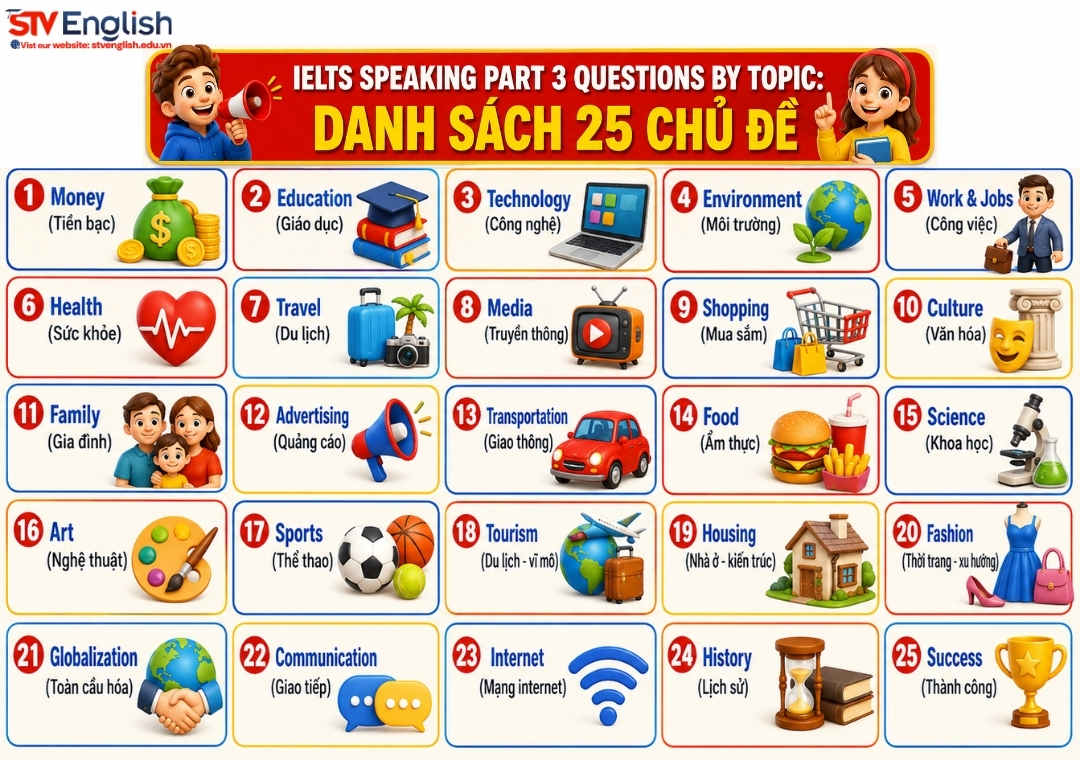
- I. IELTS SPEAKING PART 3 QUESTIONS BY TOPIC: DANH SÁCH 25 CHỦ ĐỀ VÀ CÂU TRẢ LỜI MẪU
- 1. Money (Tiền bạc)
- 2. Education (Giáo dục)
- 3. Technology (Công nghệ)
- 4. Environment (Môi trường)
- 5. Work & Jobs (Công việc)
- 6. Health (Sức khỏe)
- 7. Travel (Du lịch)
- 8. Media (Truyền thông)
- 9. Shopping (Mua sắm)
- 10. Culture (Văn hóa)
- 11. Family (Gia đình)
- 12. Advertising (Quảng cáo)
- 13. Transportation (Giao thông)
- 14. Food (Ẩm thực)
- 15. Science (Khoa học)
- 16. Art (Nghệ thuật)
- 17. Sports (Thể thao)
- 18. Tourism (Du lịch - vĩ mô)
- 19. Housing (Nhà ở - kiến trúc)
- 20. Fashion (Thời trang - xu hướng)
- 21. Globalization (Toàn cầu hóa)
- 22. Communication (Giao tiếp)
- 23. Internet (Mạng internet)
- 24. History (Lịch sử)
- 25. Success (Thành công)
Việc chuẩn bị theo hệ thống IELTS Speaking Part 3 Questions by Topic là chiến thuật quan trọng nhất giúp học sinh chinh phục band điểm cao. Phần thi này không chỉ kiểm tra ngôn ngữ mà còn đánh giá tư duy xã hội. Dưới đây là tổng hợp 25 common IELTS Speaking Part 3 topics kèm câu trả lời mẫu chuyên sâu để các em luyện tập phản xạ mỗi ngày.
Nếu bạn muốn tìm hiểu thêm các khóa luyện IELTS, hãy truy cập STV English để khám phá các khóa học chuyên sâu.
I. IELTS SPEAKING PART 3 QUESTIONS BY TOPIC: DANH SÁCH 25 CHỦ ĐỀ VÀ CÂU TRẢ LỜI MẪU
Dưới đây là các chủ đề thường gặp nhất, được thiết kế giúp học sinh mở rộng ý tưởng và sử dụng từ vựng học thuật một cách tự nhiên.
1. Money (Tiền bạc)
Is it better to save money or spend it?
I believe a balanced approach is the most practical. Saving money is crucial because it provides financial security and prepares individuals for unexpected situations, such as emergencies or future investments. However, spending also plays an important role, as it allows people to enjoy their lives and contributes to economic growth. For example, people who only save without spending may miss out on valuable experiences. Overall, the key is to manage finances wisely rather than focusing solely on one approach.
2. Education (Giáo dục)
Should higher education be free for everyone?
This is a highly controversial issue. On the one hand, free tuition promotes social equality and allows more people to access higher education. However, it can place a significant financial burden on the government and may lead to overcrowded universities. In my opinion, a partial support system, such as scholarships, would be a more sustainable solution.
3. Technology (Công nghệ)
Will robots replace humans in the workplace?
In repetitive and manual sectors, automation is already happening. Nevertheless, roles requiring emotional intelligence, creativity, and complex moral judgment will likely remain in human hands for the foreseeable future. Therefore, technology is more likely to transform jobs rather than completely replace human workers.
4. Environment (Môi trường)
Who should be responsible for protecting the environment?
It requires a collective effort. Governments must implement strict environmental regulations, while individuals should adopt sustainable lifestyles, such as reducing plastic waste and conserving energy. Without cooperation between these groups, environmental problems will be difficult to solve effectively.
5. Work & Jobs (Công việc)
What factors contribute to job satisfaction?
Job satisfaction depends on several factors, not just salary. While a competitive income is important, employees also value a supportive work environment and opportunities for career development. In addition, recognition from employers can significantly boost motivation. For instance, workers who feel appreciated are more likely to stay committed and productive. Overall, a combination of financial and emotional rewards leads to greater job satisfaction.
6. Health (Sức khỏe)
Do you think private healthcare is better than public healthcare?
I don’t think one is completely better than the other. Private healthcare usually offers faster service and more personalized treatment, which many people prefer. However, it can be very expensive and not accessible to everyone. Public healthcare, on the other hand, plays a crucial role in ensuring that all citizens can receive basic medical care.
7. Travel (Du lịch)
Why do people like to travel to foreign countries?
Traveling abroad offers people a chance to experience new cultures and lifestyles. It helps them broaden their perspectives and gain a deeper understanding of the world. For example, trying local food or interacting with people from different backgrounds can be very eye-opening. In addition, traveling is often seen as a way to relax and escape from daily routines. That’s why it remains so popular.
8. Media (Truyền thông)
How has the internet changed the way we consume news?
The digital age has made news accessible 24/7 through social media and news apps. This convenience, however, comes with the risk of "fake news" and misinformation spreading rapidly. As a result, people need to develop critical thinking skills to evaluate the reliability of information.
9. Shopping (Mua sắm)
Why do some people prefer online shopping to traditional shopping?
Convenience is the primary factor, as consumers can browse thousands of products from home. Additionally, online platforms often offer lower prices and a wider variety of choices compared to physical stores. However, traditional shopping still appeals to those who prefer a hands-on experience.
10. Culture (Văn hóa)
Is it important to maintain traditional cultures?
Yes, traditions are the bedrock of a nation's identity. They provide a sense of belonging and continuity, connecting the present generation with the wisdom and values of their ancestors.
11. Family (Gia đình)
Who should take care of the elderly, the family or the government?
Ideally, it should be a partnership. Families provide emotional support and intimacy, while the state should provide high-quality healthcare and financial assistance through pension schemes.
12. Advertising (Quảng cáo)
What makes an advertisement effective?
A successful ad usually strikes an emotional chord or uses a catchy slogan. When a brand manages to associate its product with a desirable lifestyle, it effectively captures the consumer's attention. This makes the advertisement more memorable and persuasive.
13. Transportation (Giao thông)
What are the advantages of public transport compared to private cars?
Public transport is much more cost-effective and environmentally friendly. It reduces the carbon footprint per passenger and helps decrease the overall number of vehicles on the road. This can significantly improve urban living conditions.
14. Food (Ẩm thực)
Why is fast food so popular despite being unhealthy?
Its popularity stems from the fast-paced modern lifestyle where people have little time to cook. Moreover, fast food is often engineered to be highly palatable and is usually very affordable. However, overconsumption can lead to serious health problems.
15. Science (Khoa học)
Should governments spend more money on space exploration?
Although space exploration requires significant funding, it can lead to major technological advancements that benefit daily life. For example, satellite technology improves communication and weather forecasting. However, some people believe governments should prioritize urgent issues like poverty and healthcare. In my opinion, a balanced investment is necessary.
khám phá ngay Làm chủ IELTS Speaking Part 3 Questions about Money: Từ lý thuyết đến thực chiến tại đây.
16. Art (Nghệ thuật)
Should art be a compulsory subject in schools?
I believe so. Creative subjects nurture imagination and critical thinking. Art education provides a balanced learning experience, ensuring that students develop their artistic side alongside scientific and linguistic skills.
17. Sports (Thể thao)
Do professional athletes deserve their high salaries?
One could argue they do, given their short career spans and the immense physical toll the job takes. Moreover, they generate massive revenue for the sports industry through sponsorships and ticket sales. However, some people argue that such high salaries are disproportionate compared to other essential professions.
18. Tourism (Du lịch - vĩ mô)
What are the disadvantages of living in a tourist city?
Residents often face higher living costs and seasonal overcrowding. Sometimes, local shops are replaced by souvenir stores, which can erode the authentic community atmosphere of the city.
19. Housing (Nhà ở - kiến trúc)
Should old buildings be preserved or demolished to make way for new ones?
Heritage buildings should be preserved as they represent a city's history and character. However, if a structure is unsafe, it might be necessary to replace it with a modern, eco-friendly building.
20. Fashion (Thời trang - xu hướng)
Does the way we dress reflect our personality?
Yes, to a certain extent it does. Clothing is a form of self-expression and can reflect a person’s taste and lifestyle. For example, someone who dresses formally may want to appear professional. However, it doesn’t always reflect a person’s true character.
21. Globalization (Toàn cầu hóa)
What are the benefits of globalization?
It encourages international trade and the sharing of technology. This interconnectedness has helped lift millions out of poverty and allowed for a faster global response to crises like pandemics. Nevertheless, it can also lead to cultural homogenization.
22. Communication (Giao tiếp)
Is it better to communicate by phone or by text message?
Texting is great for quick updates, but phone calls are superior for complex or emotional discussions. Hearing someone's tone of voice helps prevent misunderstandings that often occur in written text.
23. Internet (Mạng internet)
How has the internet changed the way students learn?
It has democratized knowledge, providing access to endless resources like online courses and journals. Students can now learn at their own pace and collaborate with peers worldwide. But it also requires strong self-discipline to avoid distractions.
24. History (Lịch sử)
Why are some people not interested in history?
They might perceive it as a collection of dry dates and facts rather than a living narrative. If history isn't taught in a way that relates to the present, it can seem irrelevant to their daily lives. If taught through storytelling, it could become much more engaging.
25. Success (Thành công)
Do you think successful people have to work harder than others?
Hard work is definitely an important factor in success. However, it is not the only one, as luck and opportunities also play a role. Many successful people are persistent and willing to overcome challenges. In the long run, consistency matters more than short bursts of effort.
IELTS Speaking Part 3 Questions by Topic: 25 Common Themes
Nhìn chung, làm chủ IELTS Speaking Part 3 Questions by Topic chính là chìa khóa giúp thí sinh bứt phá tư duy và đạt điểm số ấn tượng. Việc rèn luyện đều đặn với 25 common IELTS Speaking Part 3 topics không chỉ nâng cao kỹ năng ngôn ngữ mà còn xây dựng sự tự tin khi đối diện với những câu hỏi hóc búa từ giám khảo.
Khám phá ngay Khóa học IELTS - Nâng Band cấp Tốc, Cải Thiện Toàn Diện Các Kỹ Năng tại đây.
Để quá trình ôn luyện trở nên chuyên nghiệp và đạt hiệu quả tối ưu, STV English luôn sẵn sàng đồng hành cùng bạn. Với phương pháp đào tạo hiện đại, tập trung vào tư duy phản biện và phản xạ tự nhiên, STV English sẽ giúp học viên nhanh chóng làm chủ mọi chủ đề thi IELTS.
👉 Nếu bạn thấy bài viết hữu ích, hãy chia sẻ cho bạn bè và đừng quên nhấp tại đây để khám phá các bài viết hữu ích của STV English.
👉 Cùng lắng nghe những chia sẻ chân thật từ học viên đã từng học IELTS tại STV English và khám phá hành trình chinh phục mục tiêu tiếng Anh nhé!
From: Ms. Flora Thu.
Xem thêm